Box Girder Bridge Cranes

When dealing with heavy loads and lengthy spans, the strength and structural integrity of the beam are crucial factors. Box girders excel in these scenarios due to their robust construction and higher support capacity relative to profile girders. Because they are custom-fabricated for specific applications, box girders offer a wide array of sizes and designs. To assess whether a box girder is suitable for your needs, crane builders take into account various key elements like
load and span.

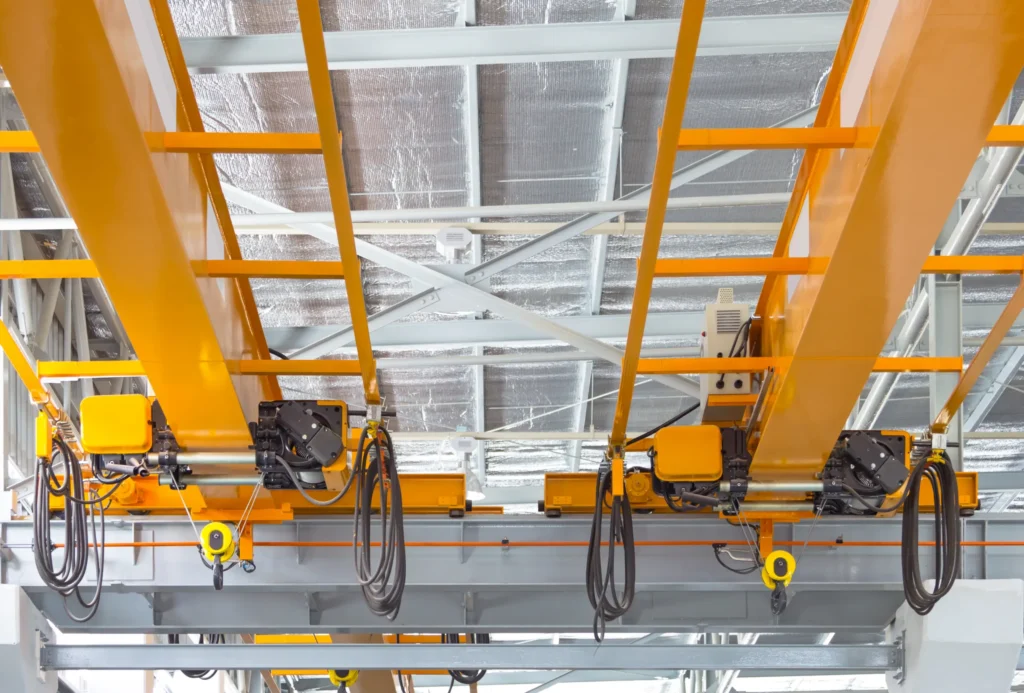
Shaped like rectangles or trapezoids, box beams feature a minimum of two webs and two flanges, and often include internal gussets that bolster the hollow structure of the beam. Their multiple vertical webs lend considerably more strength relative to the girder’s height. The compact nature of box girders makes them ideal for maximizing headroom in heavy-duty applications.

Additional Specs

Standard or American Box Beam:

In this design, the trolley rail is centrally positioned on the top of the box, optimizing the economical use of steel in the girder fabrication.

Torsional Box Beam:

Here, the trolley rail is located above the inner web of each beam in a double-girder crane. This setup exerts more pressure on the inner web as opposed to the outer one but allows the hoist and trolley to sit between the girders for a more compact design and improved headroom. Additionally, as the load shifts from the girder to the end truck, it’s further from the wheel, reducing wheel loading. This often results in smaller end trucks or runway rails and minimizes wear over the crane’s lifespan.

Request A Quote